NSC Launched NSCI Safety Awards for School - APPLY HERE| NSCI Safety Awards 2026. (Last Date extended upto 31st July 2026) - APPLY HERE| Invitation to Join NSC Experts Panel (Ergonomic and Industrial Hygeinist) - APPLY HERE| NSCI Training Calendar 2026-27 - CLICK HERE
  Apply / Nominate Now   Download Brochure

National Education Policy (NEP) 2020

The NEP, 2020 lays down the goal of every education Institution- "A good education institution is one in which each student feel welcomed and cared for, where a safe and stimulating learning enviornment exists."

National Education policy lays down the need for adequate and safe infrastructure,adopting systems to ensure that teachers and students, including children of all genders and children with disabilities, receive a safe, inclusive, and effective learning environment,and ensuring that in-service training has inputs on Safety, Health and environment at workplace in schools to ensure that all teachers are sensitized to these requirements

School Safety Award
From Director General Desk

Director General

While NSCI has made substantial contributions towards promoting workplace safety, we believe there exists a tremendous opportunity within the education sector to cultivate a culture of safety among young minds. Schools play a vital role in shaping responsible citizens and future leaders. Instilling safe behaviour, preparedness, and awareness at an early stage will significantly contribute towards building a safer and more resilient India.


In this regard, we are pleased to introduce the "NSCI Safety Awards for Schools - 2026", a pioneering national initiative aimed at institutionalizing safety culture in schools across the country. This initiative aligns with the vision of Viksit Bharat by fostering safety-conscious future generations.

Dr. Lalit R Gabhane

Dr. Lalit R Gabhane

Director General, NSCI

School Safety Excellence Awards

Perspective

The National Safety Council of India (NSCI) believes that safety culture must begin at the foundation level - in schools. Children are not only learners but future citizens, leaders, and decision-makers. Embedding safety awareness, risk prevention, and emergency preparedness at the school level creates a resilient nation.

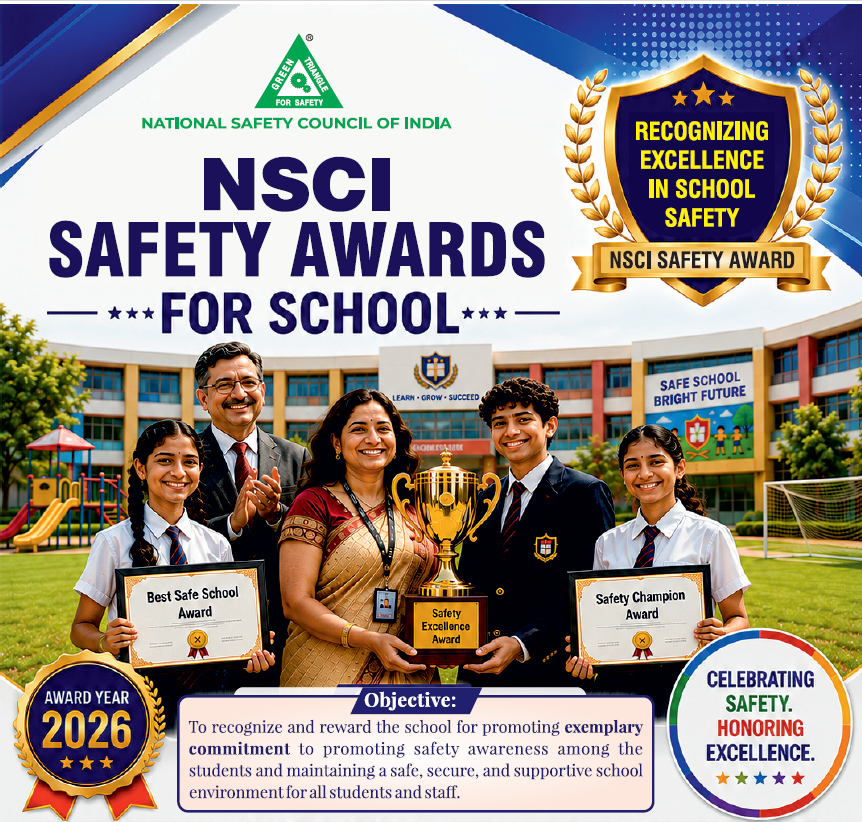
To foster a proactive safety culture in educational institutions by recognizing and encouraging excellence in school safety management systems, infrastructure, awareness programs, and student participation; NSCI are proud to announce the award scheme for school titled as "NSCI Safety Awards for School", from the year 2026. The awards will be presented at the NSCI Safety Awards Ceremony 2026.

NEP 2020 Perspective

School Safety Excellence Award Recognises

Comprehensive categories that promote a whole-school approach to safety and wellbeing.

1
Safety Culture

Safety Culture

Recognizes schools that promote safety awareness, shared responsibility, and positive safety behaviors among students, teachers, and staff.

2
Emergency Readiness

Emergency Readiness

Encourages preparedness through fire drills, evacuation planning, first-aid readiness, crisis response systems, and emergency communication.

3
Student Wellbeing

Student Wellbeing

Focuses on emotional safety, bullying prevention, mental health support, inclusion, and creating a positive learning environment.

4
Safe Infrastructure & Facilities

Safe Infrastructure & Facilities

Recognizes schools that maintain safe buildings, classrooms, laboratories, playgrounds, sports facilities, and accessibility standards.

5
Child Protection & Safeguarding

Child Protection & Safeguarding

Promotes child protection policies, safeguarding practices, reporting mechanisms, and safe environments for every child.

6
Safe Transportation

Safe Transportation

Promotes safe school transportation operations, driver training, vehicle inspections, road safety awareness, and student travel safety.

7
Health, Hygiene & Nutrition

Health, Hygiene & Nutrition

Recognizes excellence in sanitation, hygiene practices, nutrition programs, food safety, and health awareness initiatives.

8
Digital & Cyber Safety

Digital & Cyber Safety

Promotes responsible technology use, cyber awareness, online safety, digital citizenship, and data privacy protection.

9
Disaster Risk Reduction & Resilience

Disaster Risk Reduction & Resilience

Encourages preparedness for natural and man-made hazards through risk assessment, drills, planning, and resilience building.

10
Community & Parent Engagement

Community & Parent Engagement

Recognizes active involvement of parents, local authorities, emergency services, and communities in building a safer school.


Who Can Apply?

Any recognized school affiliated with State, National, International, or Private National Boards can apply.

Eligible Schools

Schools imparting elementary education and recognized under applicable norms are eligible, including institutions managed by Government, local authorities, aided bodies, specified categories, and unaided managements.

As defined under Section 2(n) of the Right of Children to Free and Compulsory Education Act, 2009.
01
Government / Local Authority Schools

Schools established, owned, or controlled by the appropriate Government or local authority.

02
Aided Schools

Schools receiving aid or grants to meet whole or part of their expenses.

03
Specified Category Schools

Schools belonging to specified categories as recognized under applicable education rules.

04
Unaided Schools

Schools not receiving aid or grants from the Government or local authority.

Assessment Groups

School Categories

Schools are classified into two groups for fair and equitable assessment.

Group A
State Board Schools

Schools affiliated with State Board approved curricula.

Group B
National / International Board Schools

Schools affiliated with CBSE, CISCE/ICSE, IB, IGCSE, NIOS, International, or Private National Boards.


Award Levels & Prizes

Awards are structured across four levels to recognize a spectrum of safety performance, from Good to Most Outstanding.

1st

SARVASHRESHTHA SURAKSHA PURASKAR

Most Outstanding Performance

Gr A: 1 | Gr B: 1 | Total: 2
Golden Trophy & Certificate
2nd

SHRESHTHA SURAKSHA PURASKAR

Outstanding Performance

Gr A: 2 | Gr B: 2 | Total: 4
Silver Trophy & Certificate
3rd

SURAKSHA PURASKAR

Very Good Performance

Gr A: 3 | Gr B: 3 | Total: 6
Bronze Trophy & Certificate
4th

PRASHANSA PATRA

Good Performance

At the discretion of Awards Committee
Certificate only

Note: *The minimum qualifying score for receiving trophy-level awards is 65% in overall assessment. Schools scoring 65% and above that do not receive a trophy will be issued a Certificate of Merit.


How to Apply

Follow the simple step-by-step process to submit your school safety award application.

Assessment Process
01

Receipt of Application

02

Assessment by Technical Expert

03

Field Visit (Shortlisted Schools)

04

Presentation Before Awards Committee

05

Declaration of Winners

06

Awards Ceremony

Application Guidelines
Application Fee Rs. 10,000 + GST
  • The Application Form is available for free download on NSC website at https://nsc.org.in
  • Read carefully the Rules & Regulations and Instructions for filling-up & submission of the application form.
  • The Application Form Offline submission:

i) Send the filled-in Application Form (one hard copy and one soft copy in pen-drive) along with a payment in the form of Demand Draft towards a processing fee. If payment is made by Online/NEFT/RTGS/BANK transfer, provide its details at the space provided in the Application Form.

ii) The filled-in Application Form can be sent by post/courier or hand delivery at National Safety Council, Plot No. 98-A, Sector-15, CBD Belapur, Navi Mumbai â€" 400 614.

Last date for receiving the application: 30th September 2026

Frequently Asked Questions (FAQ's)

Find quick answers to the most common questions about eligibility, application process, evaluation criteria, and award recognition.

1. Who can apply for the School Safety Excellence Award?

Schools affiliated with State Boards, National Boards (such as CBSE, ICSE, NIOS), and International Boards (such as IB and IGCSE) are eligible to apply under their respective categories.

2. How can schools submit their application?

Schools can download the application form from the NSC website, complete it, and submit one hard copy along with one soft copy (pen-drive). Applications can be submitted by courier, post, or hand delivery to the National Safety Council office.

3. What are the evaluation criteria for the award?

Applications are assessed across key safety areas such as Safety Culture, Emergency Readiness, Student Wellbeing, Infrastructure Safety, Child Protection, Transportation Safety, Health & Hygiene, Cyber Safety, and Disaster Risk Reduction.

4. What are the different award levels?

The awards are structured into four levels:

  • Sarvashreshtha Suraksha Puraskar (Golden Trophy & Certificate)
  • Shreshtha Suraksha Puraskar (Silver Trophy & Certificate)
  • Suraksha Puraskar (Bronze Trophy & Certificate)
  • Prashansa Patra (Certificate Only)
5. What is the minimum qualifying score for receiving an award?

Schools must secure a minimum of 65% in the overall assessment to qualify for trophy-level awards. Schools scoring 65% or above but not selected for trophies will receive a Certificate of Merit.


School Safety Resources

Download important school safety and security guidelines.

NCPCR Guidelines on School Safety and Security

NCPCR GUIDELINES ON SCHOOL SAFETY AND SECURITY

Download PDF
NDM Guidelines for School Safety Policy

NDM GUIDELINES FOR SCHOOL SAFETY POLICY

Download PDF

Important Dates

Please update these dates as per the final schedule approved by NSCI.

Announcement Date

April 2026

Last Date to Apply

30th September 2026

Result Declaration

31st December 2026

Application Fees

Rs. 10,000 + GST


Whole School Approach

A collaborative model that unites the school community to create safe, inclusive, and supportive learning environments.

Collaborative Framework

The Whole School Approach is a collaborative framework that engages all members of the school community-students, teachers, school leaders, parents, and support staff-in creating a positive and supportive learning environment.

It recognizes that student success depends not only on academic instruction but also on social, emotional, physical, and psychological wellbeing.

Transforming School Communities

A Whole School Approach transforms schools into thriving communities where every individual feels valued, supported, and empowered to reach their full potential.

By working together, schools can create sustainable and meaningful improvements in both educational outcomes and student wellbeing.

1

Students

Active participation, student voice and leadership for a safer school community.

2

Teachers

Well-trained, supported and empowered teachers who promote safe learning practices.

3

School Leadership

Visionary, inclusive and accountable leadership for whole-school safety improvement.

4

Parents & Families

Strong partnership with families to support learning, wellbeing and student success.

5

Community & Partners

Collaboration with local communities and partners to strengthen school support systems.

6

Support Staff

Essential support staff contributing to a safe, healthy and caring school environment.


For OHS solutions we are available to you